Engineering services for satellites and strategic systems, from development build zero to flight.
We design the electronics, write the flight firmware/software, develop the algorithms, build the ground processing, and take the hardware into the beam to prove it survives. Senior engineers stay on your program from the first schematic to the final report.
End-to-end R&D for space and strategic environments. We take a program from concept through delivered hardware, or step into whichever stage needs help.
Electronics design
Payload and instrument electronics, high-speed digital, radiation-tolerant part selection and mitigation. Turnkey builds from schematic through layout, procurement, assembly, and checkout.
Flight firmware and software
Flight software, command and data handling, FPGA firmware for sensor interfaces and high-rate data paths.
Algorithm development
Signal processing, detection and classification, and sensor fusion.
Ground processing software
Pipelines, data products, and analysis tooling that turn downlinked bits into answers.
Radiation effects testing
We have run 40+ campaigns across every environment that matters for space and strategic systems: proton, heavy ion, neutron, flash x-ray, and total ionizing dose.
We specialize in complex parts: SoCs, FPGAs, high-density memories, and custom ASICs, where the test harness is most of the work. A well-designed harness can significantly reduce the beam time required to meet test objectives.
We run the campaign end to end:
Planning and fixtures
Test planning against your environment and part list, fixture board design, and DUT driver and data acquisition software.
Test execution
We run the shift. Beam-time planning, DUT swaps, live monitoring of every channel, and the fixture or software change made on the spot when the first run shows something the plan did not. Beam time is the expensive part of a campaign, and we treat it that way.
Analysis and reporting
A report you can hand to your radiation effects board: cross sections, dose response, and part qualification recommendations.
What we have put in the beam.
Device classes from recent campaigns:
Next-gen technology nodes
Commercial SoCs & FPGAs
Custom ASICs
Serial & parallel SRAM/MRAM/FRAM
Ethernet PHY & switch ICs
DDR4/LPDDR4 & DDR5/LPDDR5
Fixtures range from modified vendor eval boards to fully custom multi-DUT test systems, chosen by what gets your part to the beam fastest.
Typical time from hardware in hand to test-ready, across 2026 campaigns:
Fixture approachTime to beam
Modified vendor eval board
3days
Eval board plus custom support hardware
2weeks
Part swap onto a host development kit
3weeks
Fully custom hardware and software
4weeks
Recent work
4months, concept to flight
Sounding rocket payload delivered in four months.
Custom electronics processing real-time inertial and position data in flight. Designed, built, integrated, and delivered.
LEOnow on orbit
Experimental module in low Earth orbit.
Schematic, layout, fabrication, assembly, and electrical checkout of a module that is now on orbit.
64-bitECC block RAM
Next-generation FPGA SoC characterization.
A next-generation FPGA SoC needed single-event characterization across GPIO, PLLs, DSPs, configuration memory, 64-bit ECC block RAM, and the scrubber. The ECC BRAM alone required a pin count most fixtures cannot reach. However, this width enabled measuring statistically meaningful error rates in a fraction of the beam time a narrower interface would need.
3days to test-ready
Ethernet ICs test-ready in three days.
A customer needed heavy-ion SEU and SEL data on Ethernet PHY and switch ICs. We modified off-the-shelf eval boards for power injection and current monitoring and were test-ready three days after the hardware arrived.
6memories on one test system
Six memory parts on one test system.
Six serial and parallel MRAM and FRAM parts needed characterization across heavy ion, flash x-ray, neutron, and TID. We built one test system with swappable DUT sites and custom software, ready in two weeks, and carried it through every environment.
4weeks to beam
LPDDR5 on a modified development kit.
The memory only exists soldered to a host. We took an SoC development kit, swapped the DRAM, wrote the driver and power-monitoring software, and were in the beam in four weeks.
FXRredesigned and requalified
Flash x-ray fixture redesign.
A customer's existing test fixture was failing destructively under flash x-ray. We redesigned it to survive the environment and requalified it at the facility.
How we work
01
Senior engineers on every job.
A principal engineer owns your program from proposal through delivery, and stays hands-on throughout the process.
02
Proposal to delivery.
We have led programs as principal investigators from the first concept through delivered hardware, so we know what the end state has to look like before the first schematic.
03
Revector in a meeting, not a contract mod.
Requirements move. We move with them without a change-order fight.
04
We deliver the documentation with the hardware.
Schematics, firmware sources, test data, and the report, in a state someone else can pick up.
Team
Hunter Earnest
Co-Founder
Electrical engineer. Hunter co-founded DevBuildZero after several years at Sandia National Laboratories, where he was principal investigator and lead engineer on space-based R&D programs and carried them from proposal to delivered hardware. He designs satellite electronics and embedded systems for strategic programs, and he leads the company's radiation work from fixture design through campaign execution.
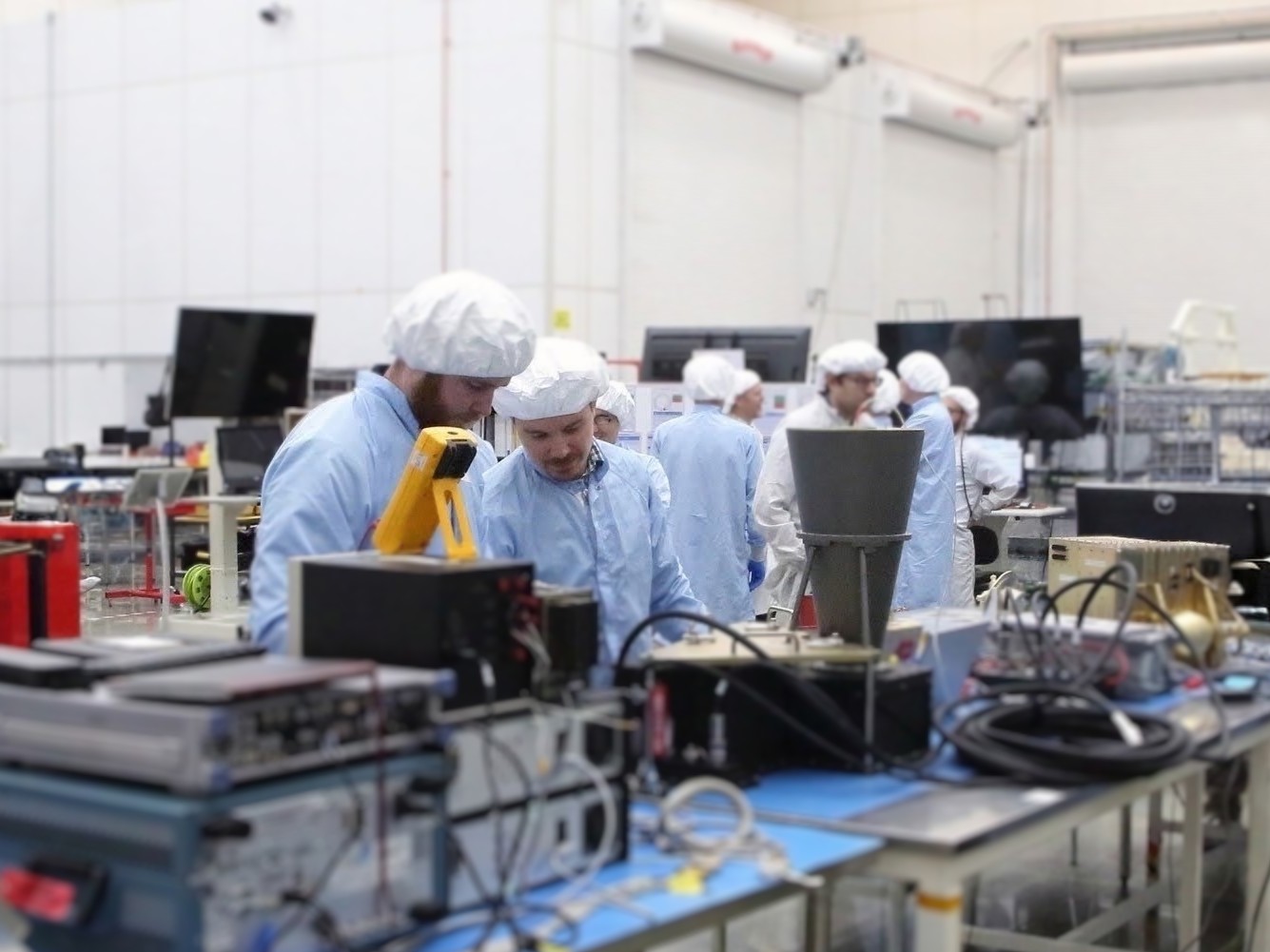
Hunter (left) and Willie (right) during satellite payload integration in a highbay.
Willie Marchetto
Co-Founder
Computer and astronautical engineer. Before DevBuildZero, Willie was chief engineer and principal investigator at Sandia National Laboratories on ground- and space-based R&D programs. His background runs from satellite electronics and flight software through machine-learning target recognition and high-performance computing to the ground software and infrastructure that tie a system together.
Doing business with us
Small business.ITAR registered.Cleared facility.
Based in Ozark, Missouri. We travel to your facility and to the beamline.
541715 Research and Development in the Physical, Engineering, and Life Sciences. 541330 Engineering Services. 927110 Space Research and Technology. 541511, 541512, 541519, 541690, 541990.
PSC
AC33 National Defense R&D Services, Experimental Development. AR13 Space R&D Services, Experimental Development. AS23 Aerospace Research, Experimental Development.
Contact
Send us your problem statement. A paragraph and a rough schedule is enough to start.